
Unit Ten & the Scorpion Locomotion

Updated: May 16
28th of March 2026
In this brief, I will focus on analyzing Scorpion locomotion and its fundamental principles.
Scorpions are arachnids with eight legs, like spiders. I will analyze their limb extension patterns and use the spider rig process and formula for my study.
My work starts with looking at live action references, whereby I can closely analyse Scorpio's motion and walk.

The rig we are using for this work is from Kiel Figgins and is available on the Animation Buffet for free. The only issue with this rig is that it has only 6 legs instead of 8; however, this doesn’t affect my work at the moment. I like to achieve a realistic motion. Otherwise, it is a great rig and easy to use. It can be used in both IK and FK modes; however, for this project, it is advised to work in IK mode.
The animation will be a 16-frame cycle, so I set up my timeline for 17 frames. For the easier workflow, it is a good idea to create shelf tabs for the body controls, so I can quickly select them when needed. Also, it is very important to turn on the post- and pre- infinity cycles for each leg, as this is key in creating an endless loop. I started with the front legs, following the principles of a bipedal walk. Firstly, I had to move the front left leg into position. Frames 1 and 17 had to be the same, while frame 9 is the opposite mirror image of them.

This was followed by adding the " up" position at frame 13, where the leg is moving up and forward again. At this point, the leg movement was quite convincing, but I need the leg flat on the surface until frame 9, so for this, I had to edit the Translate Z curve and straighten it out. The line between frames 1 and 9 had to be as straight as possible. Once all of these were done, I selected all my curves in the graph editor (Translate X, Y and Z) and pasted them onto the front right leg.

I also had to make sure to turn on the Infinity cycles on this leg, too, and I had to keep in mind to do this for each control curve. At this point, the two front legs were moving in the same direction, so I had to select all the curves on the front right leg and offset them by 8 frames (moving them backwards in the graph editor). Once these were done, I carried on to copy and paste the same curves onto the other legs and offset them by 8 frames where needed. I had to make sure that they counteract the legs in front of them. The easiest to do was the last pair of legs, as they had the same move as the front ones.
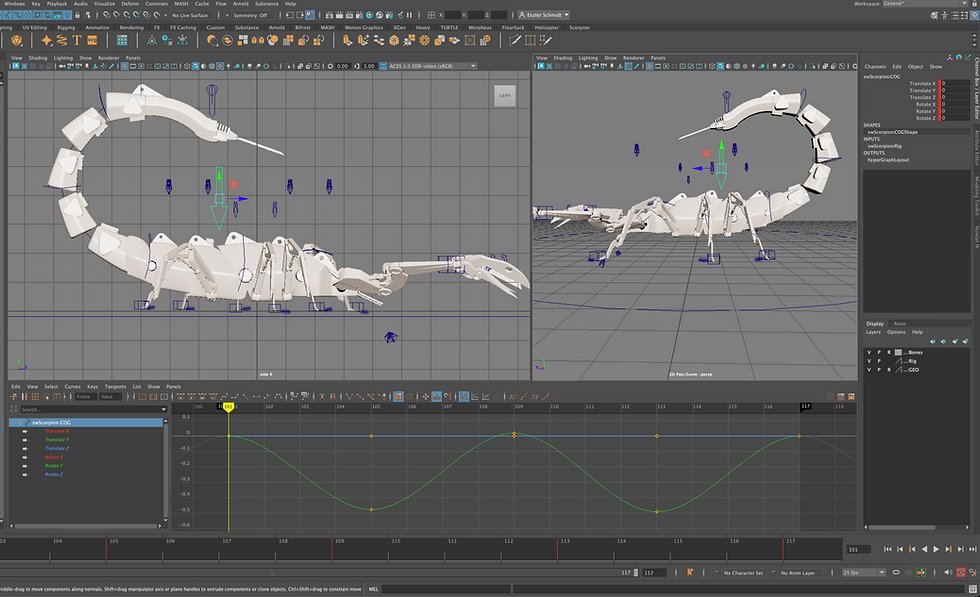
When the legs were done, the next step was to add 'up' positions at frames 1, 9 & 15 and 'down' positions to frames 5 & 13 to the scorpion's body.

In order to add further flexibility, I had to give movement to the tail. The Scorpion's tail carries the same importance as for other animals. It is essential for its balance, navigation, defence, and hunting. In the case of my work, I focus on its role in stabilisation during motion (Hang Shu, 2025). I started with up and down positions. I selected the first spine curve and, using the rotation X curve added moved it down when the body was up, and rotated it up when the body was down. At this stage, the tail had a synchronised movement with the body, so in order to add more flexibility again, I had to set off the X curves by two frames. Then I followed with a little side-to-side motion added to the rotation curve Y at frames 1, 9, 13 and 17. Once done, I moved the curved 8 frames forward to create an overlapping movement. I continued the work with the remaining spine controls.

Further flexibility could be added with the head control, which had to oppose the body movement. When the body was down, the head went up, and when the body went up, the head went down. Offsetting the curves is essential again in creating overlapping action and flexibility. Once I cleaned up the waves in the graph editor and made sure there were nice sine waves, I selected the X curve and offset it by two frames to the left. After this, I went ahead to add a bit of side-to-side motion. As we know, head motion during walking is part of basic coordination and balancing. By following this principle, when the right leg came forward, I rotated the head slightly to the right, and when the left leg came to the front, I turned the head slightly to the left. It turned out that I had too many frames set for this, and the movement was a bit of a mess, so I deleted the unnecessary frames and kept only frames 1, 9 and 17.
At this stage, the motion was much more realistic, so I needed only a little refinement. I started with the claws and followed the principles of the basic gait. When the body & the head moved to the right, the left claw had to be moved slightly to the left, and to the right when they moved to the left.
For further improvement I started to work with the head, which had to oppose the body movement. When the body was down, the head went up, and when the body went up, the head went down. Once I cleaned up the waves in the graph editor and made sure there were nice sine waves, I selected the X curve and offset it by two frames to the left. After this, I went ahead to add a bit of side-to-side motion. As we know, head movement during walking is part of basic coordination and balancing. By following this principle, when the right leg came forward, I rotated the head slightly to the right, and when the left leg came to the front, I turned the head slightly to the left. It turned out that I had too many frames set for this, and the movement was a bit of a mess, so I deleted the unnecessary frames and kept only frames 1, 9 and 17.
At this point I was quite happy with my cycle, so the next step is to add a simple set. i found a very nice Terrain set created by By Xenija_D. I it is available for free on Turbosquid.
References:
Academy of Art University (2022) The role of sound design in animation. Available at: https://www.youtube.com/watch?v=gzszFCxFKNo
Journal of Medical Engineering (Oxford Academic article) (n.d.) Available at: https://academic.oup.com/mt/article/30/1/8/6813939
IOP Science (n.d.) Article on biomechanics / physics in biological systems. Available at: https://iopscience.iop.org/article/10.1088/1748-3190/addc24
Pond5 (n.d.) Scorpion walking around cinematic slow motion stock footage. Available at: https://www.pond5.com/stock-footage/item/126204657-scorpion-walking-around-cinematic-slow-motion


Comments