
Beyond Realism: How Stylisation and Sound Create Emotional Connection In The Wild Robot

Updated: Aug 29
15th of July 2026
Induction
This essay investigates the animated film The Wild Robot (2024) by DreamWorks Animation and analyses its stylised visual style and how different elements work together to create an emotional experience. Although the movie seems to reject photorealism, its stylized visuals, believable character animation, and sound create a strong emotional connection.

Visual style and stylization
This study investigates whether the movie’s stylized approach effectively conveys the narrative despite moving away from photorealistic representation. Following The Oxford Dictionary’s explanation of realism in terms of paintings and movies, it is “the quality of being very like real life” (Oxford Advanced Learner’s Dictionary, 2005, p. 1256). Reviewing The Wild Robot's painterly design suggests that its visual style deliberately moves away from a photorealistic aesthetic. The hand-painted texture, even though it is combined with CGI technology, takes it further away from photorealism. While the distinctive imagery reminds the viewers of the old-fashioned 2D backgrounds and storytelling, it raises the question whether the movie can generate the same level of empathy as a more realistic animation. The Wild Robot’s textured backgrounds, shapes and atmospheric colour palettes seem to simplify the visual information and direct the attention towards the characters' emotional performances rather than photorealistic details. The creators intentionally used brushstroke textures along with blurring to simplify images, creating artistic depth of field while increasing the focus on the performance. This suggests that the film prioritises expressive communication over life-like imitation. This observation supports Boulos's (2016) argument that stylization selectively keeps aspects of reality rather than rejecting them entirely. Lee et al. 's (2017) study found that incorporating realistic elements into character design did not have a significant impact on the audience's perception of empathy. However, in The Wild Robot, the combination of stylised character design and recogniszble animal behaviour contributes to the characters' believability.
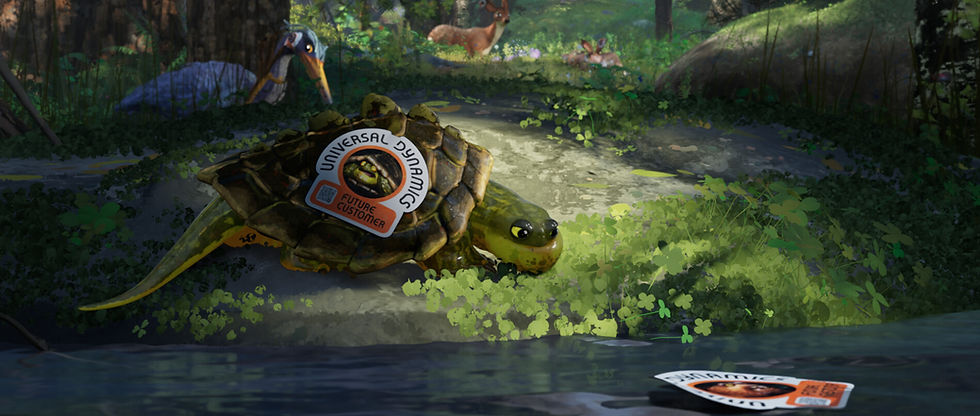
Lighting and colour as emotional aspects
Another powerful tool that the creators used expressively is lighting. The movie uses cinematic lighting that enhances the narrative and emotions and creates the illusion of depth and a sense of space. It helps to emphasize emotional expression and enhance emotional engagement. Roz's and the other robots' emotions are suggested by their colour changing LED lights. In key scenes, gentle morning and evening lights reinforce friendly emotions and safe environments, while darker effects contribute to more tense moments in the story.

Colour can influence emotional and psychological responses, although these effects are dependent on context and other factors (Elliot and Maier, 2014). In The Wild Robot, red tones are repeatedly associated with danger and tension, while warmer amber tones contribute to scenes with belonging and safety. These associations are reinforced by the surrounding lighting, environment and character performance.

Believability through character behaviour
The visual identity is only one part of storytelling, and behavioral aspects are also worth investigating. Focusing on the animals in the Wild Robot, it is evident they are highly stylized, matching their environment, and they do not follow real-life anatomical accuracy. Their movement, body language, and behaviour, on the other hand, make them feel alive and, most importantly, make them believable. While their facial features and bodies are highly stylized to enhance expressions and exaggeration, their body language shows realistic aspects possibly referenced by real-life behaviour and animal instincts. Examples of this are the simplified expressions where the animals walk on their four legs, and they resemble realistic body motions according to their species, unless the story requires an exaggerated, stylized movement to reinforce the story.

Fink’s body language is also worth mentioning, like his anticipation when hunting and jumping, sniffing, licking his lips and yawning just like a living fox responding naturally to his environment. His lowered body posture and positioning of the head and ears when alert shows similarity to real fox behaviour. In contrast, Roz's character, despite her rigid robotic form, displays many recognisably human behaviours. Her emotions are well expressed through her eyes, which is supported by her body language. Her character’s actions reflect warmth, kindness, curiosity, and confusion. These recognisable behaviours reflect familiar patterns, and following Lee et al. (2017), character design can influence emotional response and empathy towards animated characters.
Sound as a bridge between stylization and realism
The interaction of style, behaviour, and lighting establishes the movie’s emotional tone, however, sound can further extend this audiovisual relationship. According to Chion, sound provides "added value", which he defines as the informative and expressive value added to an image. It supports the message, solidifies the meaning, and interprets it to the audience. In the case of an animated movie, usually every sound is built by the creators (dialogue, ambient sound, sound effects, even music). The image and its accompanying sounds contribute to the meaning and identity of the film's world. Chion’s theory identifies two contrasting sound concepts: empathetic and anempathetic sound. Empathetic sound matches the scene’s emotional tone and contributes to the audience’s emotional response, while anempathetic sound contrasts with the action, creating an impression of emotional indifference. An example of empathetic sounds can be seen in the movie’s migration scene where Brightbill joins the migration after learning to fly. The music reflects the joy and triumph of the characters while simultaneously emphasising the scale and movement of the visuals. In contrast, anempathetic sound can be observed at the beginning of the film, when the chaotic destruction of the wilderness is accompanied by playful music. This creates an unusual contrast between what the audience sees and hears, making the wilderness chaos feel both unsettling and playful.

The Wild Robot’s stylized environment is characterized by natural sounds like the nature, the sea and the forest ambience. The audience can experience the birds chirping and the wind blowing. Even though the visual language is stylized, the accompanying sounds contribute to creating a believable world. While the animals sound just like any character in animated movies, here they are edited with real animal sounds, too.
Their howls, growling, and whining all reflect realistic sound effects. It is also interesting how Roz’s voice evolves throughout the movie. Her voice is combined with human vocal characteristics and machine-like monotone. The fact that she is a robot is further emphasized by the added resonance to her voice and hollow metallic body.However, as her behaviour becomes emotionally more expressive, the sound of her voice becomes less mechanical. Towards the end of the movie, the audience experiences a strong character development, and she seems to lose the inhuman aspects in her voice, just like her character's behaviour. The music throughout the movie is emotional and supports Roz's and the animal’s transformation. It accompanies the acting and dialogue well, while reinforcing wonder, providing comfort and building tension, and strengthening the emotional meaning of the visuals.
In conclusion, the Wild Robot demonstrates that photorealistic representation is not essential for emotional connection and achieving empathy. Believability is created through the interaction of stylisation, movement, lighting, and sound rather than through photorealistic imagery.
References:
Boulos, D.N. (2016) ‘Abstraction and Stylized Design in 3D Animated Films: Extrapolation of 2D Animation Design’, in Encyclopedia of Computer Graphics and Games. Springer. doi: 10.1007/978-3-319-08234-9_58-1.
Chion, M. (2019) Audio-Vision: Sound on Screen. Translated by C. Gorbman. New York: Columbia University Press.
Desowitz, B. (2024) ‘The Wild Robot: Animation painterly, Chris Sanders interview’, IndieWire. Available at: https://www.indiewire.com/features/animation/the-wild-robot-animation-painterly-chris-sanders-interview-1235050351/(Accessed: 12 August 2026).
DreamWorks Animation (2024) The Wild Robot [Film]. Directed by Chris Sanders.
Elliot, A.J. and Maier, M.A. (2014) ‘Color psychology: Effects of perceiving color on psychological functioning in humans’, Annual Review of Psychology, 65, pp. 95–120. doi: 10.1146/annurev-psych-010213-115035
Lee, Y., Choi, Y. and Jeong, J. (2017) ‘Character drawing style in cartoons on empathy induction: an eye-tracking and EEG study’, PeerJ, 5, e3988. doi: 10.7717/peerj.3988.
Oxford Advanced Learner’s Dictionary (2005) Oxford Advanced Learner’s Dictionary. 7th edn. Oxford: Oxford University Press.
Images:
Figure 1 and Figure 4: Bareham, J. (2024) ‘The Wild Robot is “painted by hand” animation at its absolute best’, Medium, 13 December. Available at: https://medium.com/@Happicamp/the-wild-robot-is-painted-by-hand-animation-at-its-absolute-best-bef21d7e3d40 (Accessed: 15 July 2026).
Figure 2 and Figure 3: Lorelai VFX (2024) The Wild Robot [Online portfolio images]. Available at: https://lorelaivfx.com/projects/6LNAx0?album_id=2027240 (Accessed: 15 July 2026).
Figure 3 TheAverageDimentio (n.d.) ‘Pure Evil Proposal - Vontra from The Wild Robot’, Villains Wiki. Available at: (Accessed: 12 August 2026).
Figure 4 Besa, H.D. (2024) ‘Is the Wild Robot Emotional? Understanding Roz’s Emotional Growth’, TheGWW, 29 August. Available at: turn0view1 (Accessed: 12 August 2026).
Figure 5 beaucer (2024) ‘Fink the fox wandering around the wild robot movie’, DeviantArt, 26 October. Available at: turn0view2 (Accessed: 12 August 2026).
John3 (2019) ‘Fox Grass Running Scared Wallpaper Background Best Stock Photos - Image ID 156672’, TopPNG, 30 April. Available at: turn0view3 (Accessed: 12 August 2026).
Tenor (n.d.) ‘Running With A Deer Roz GIF’, Tenor. Available at: Tenor GIF (Accessed: 12 August 2026).
Adobe Stock (n.d.) ‘Running deer images – Browse stock photos, vectors, and video’, Adobe Stock. Available at: Adobe Stock search page (Accessed: 12 August 2026).
Figure 6 Combemale, L. (2024) ‘“The Wild Robot” Composer Kris Bowers on Accessing a Robot’s Humanity Through Music’, The Credits, 4 November. Available at: (Accessed: 12 August 2026).


Comments